Vancouver, British Columbia--(Newsfile Corp. - October 1, 2026) - West Point Gold Corp. (TSXV: WPG) (OTCQX: WPGCF) (FSE: LRA0) ("West Point Gold" or the "Company") is pleased to report that following the receipt of permits and the completion of bonding, Kinross Gold U.S.A., Inc. ("Kinross"), a wholly owned subsidiary of Kinross Gold Corporation, has commenced drilling at West Point Gold's Jefferson Canyon project in Nye County, Nevada.
Highlights
- Kinross has commenced drilling on September 23, 2026, at West Point Gold's Jefferson Canyon, located approximately 7 kilometres from its Round Mountain operations.
- Partner-funded exploration allows West Point Gold to retain exposure to Jefferson Canyon while allowing the Company to remain focused on its flagship Gold Chain Project.
- Permits were received August 19, 2026, starting the four-year option period laid out in the 2022 Exploration and Option Agreement (the "Agreement").
- The Agreement provides for the potential of up to US$10 million in future option payments.
- West Point Gold retains meaningful long-term exposure to Jefferson Canyon, including a 20% project interest if both Kinross options are exercised and royalty protection should its interest subsequently be diluted below 10%.
"We are excited that drilling has begun at West Point Gold's Jefferson Canyon project. The historical drilling and work we previously completed suggest this project has the potential to deliver a significant deposit. Given the project's proximity to Kinross's Round Mountain mine and our partnership on the Jefferson Canyon project with Kinross, we believe the hurdle rate to define a mineable deposit is relatively low," stated Derek Macpherson, President & CEO.
Jefferson Canyon Project, Nevada
The Jefferson Canyon project in Nye County, Nevada is located 7 kilometres from Kinross's Round Mountain operations (Figure 1). The project has 145 historical drill holes, including 41.2m at 6.4 g/t gold and 402 g/t silver (GJ-81). In 2022, West Point Gold entered into an Exploration and Option Agreement with Kinross (the "Agreement"). Kinross has made all the required payments associated with the agreement to date.
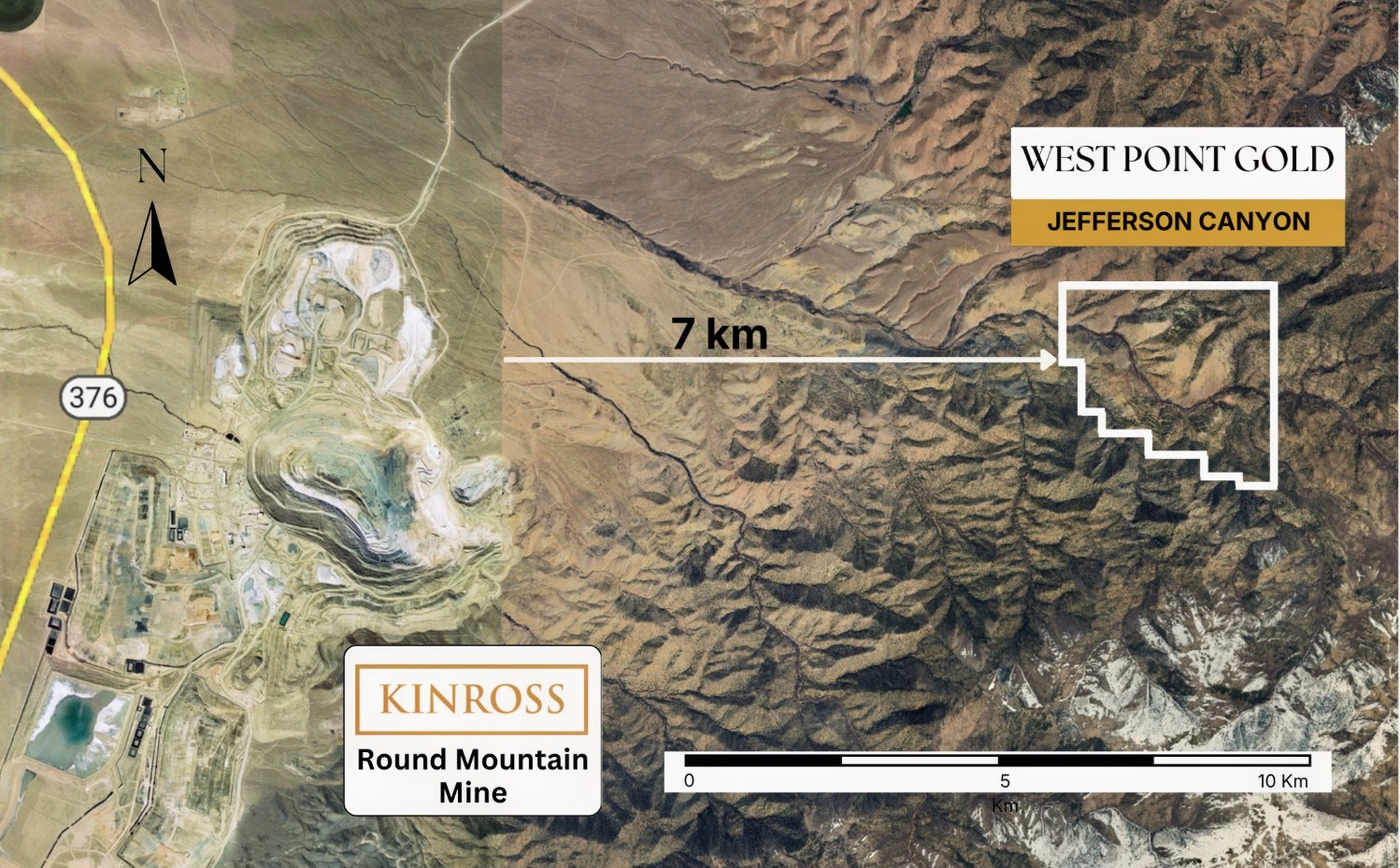
Figure 1: Jefferson Canyon Project Relative to Round Mountain
To view an enhanced version of this graphic, please visit:
https://images.newsfilecorp.com/files/5717/316830_bb7e6c53c4253965_002full.jpg
The Jefferson Canyon project contains a large volcanic-hosted epithermal Au-Ag system that is essentially the same age as the nearby Round Mountain deposit, a world-class low-sulfidation (LS) epithermal deposit. Both are hosted in felsic ash-flow tuffs along the margins of calderas and both contain a strong northwest-trending and north-south structural control to veins. Both areas contain low-grade disseminated and high-grade vein or replacement-type mineralization.
Historical drilling has defined multiple zones of mineralization (Figure 2) and has been highlighted by multiple significant drill intercepts, including 41.2m of 6.4 g/t Au and 402 g/t Ag (GJ-81).
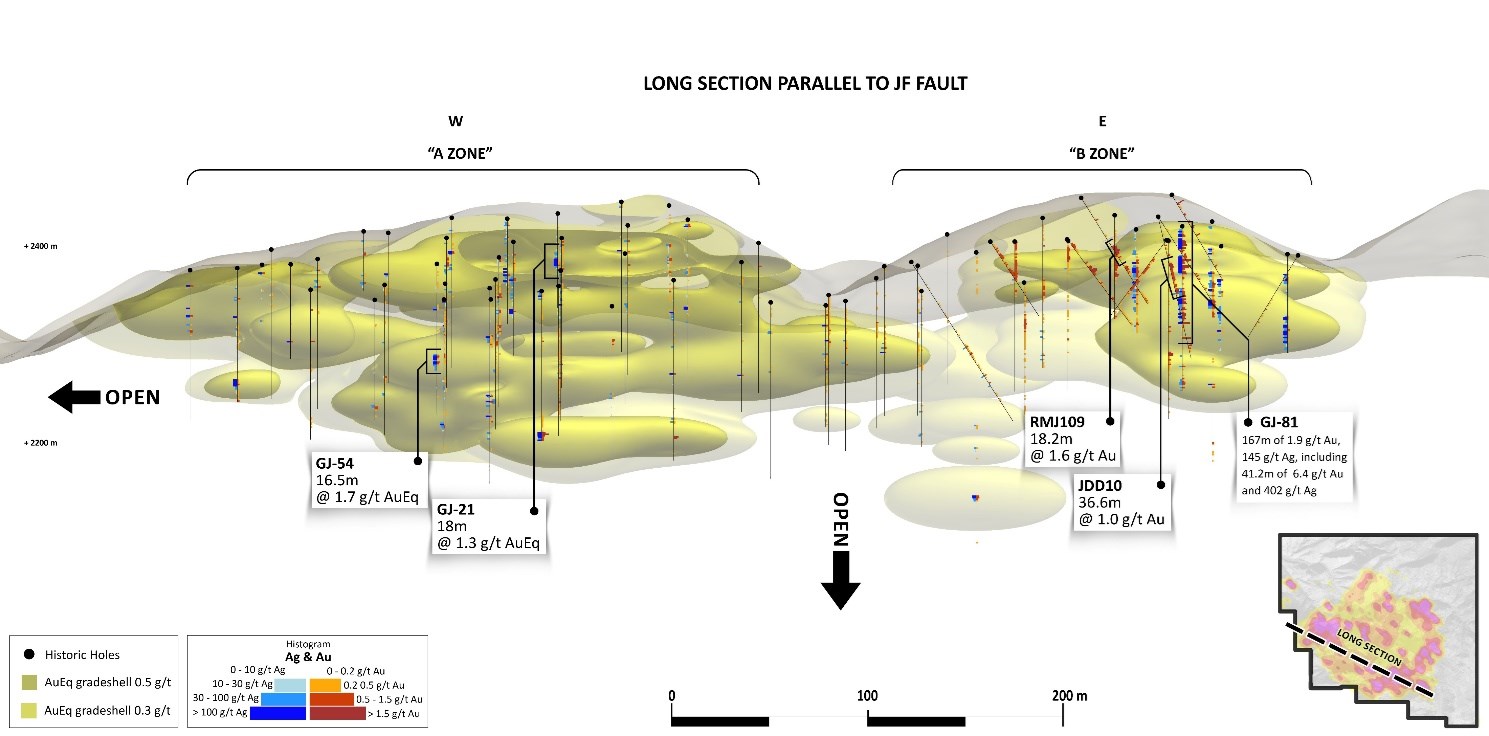
Figure 2: Historical Drill Holes and Mineralized Envelope along the Jefferson Canyon ("JF") Fault
To view an enhanced version of this graphic, please visit:
https://images.newsfilecorp.com/files/5717/316830_bb7e6c53c4253965_003full.jpg
Soil sampling in 2021 revealed a four-square-kilometre circular gold-in-soil anomaly (Figure 3). The highest Au-in-soil value was 4,470 parts per billion Au and anomalous values were distributed as follows: 29 samples contained greater than 500 parts per billion Au; 99 samples were greater than 200 ppb Au; 234 samples were greater than 100 ppb Au; and, 631 samples were greater than 20 ppb Au. The five rock samples collected were anomalous, with values of up to 15.2 g/t gold and 421 g/t silver.
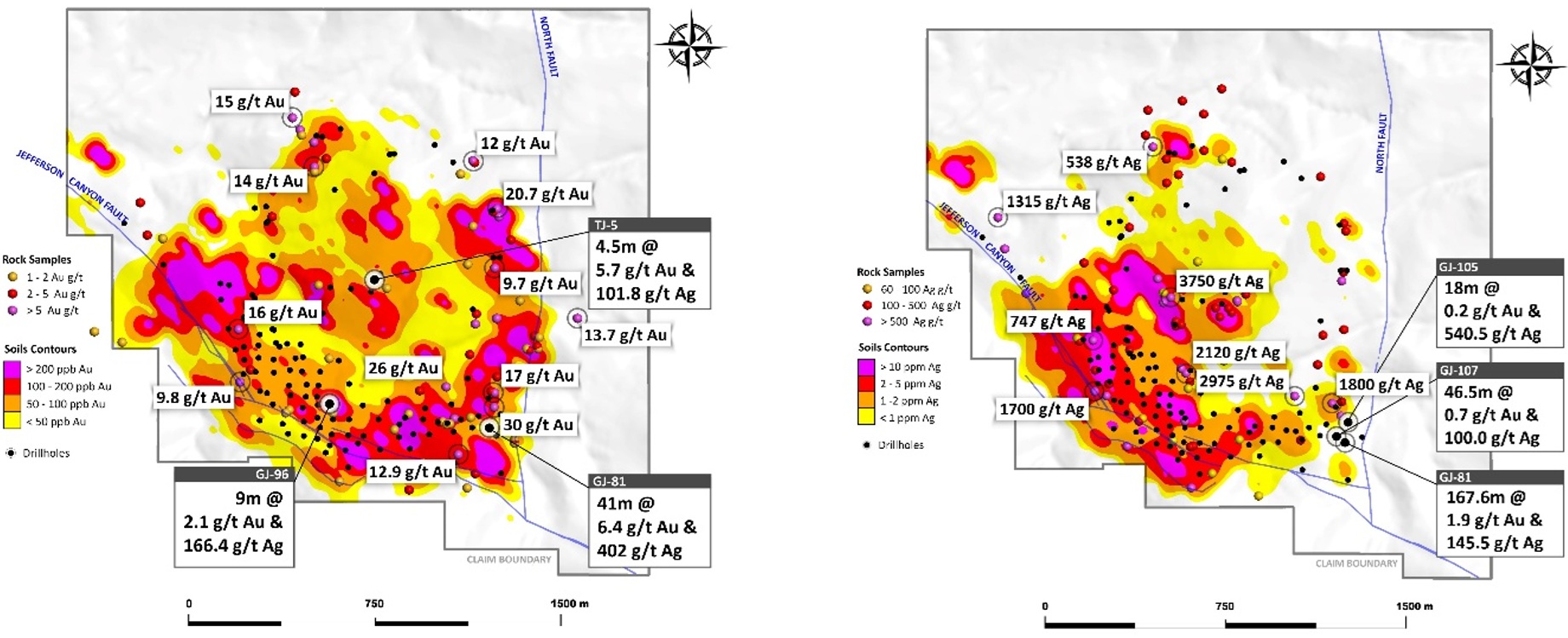
Figure 3: Gold-in-Soil and Silver-in-Soil Anomalies at Jefferson Canyon with historical drill collars
To view an enhanced version of this graphic, please visit:
https://images.newsfilecorp.com/files/5717/316830_wpg-figure3.jpg
The CSMAT resistivity data suggests that the Jefferson Canyon fault is a deep structure which likely controls mineralization. This spatial relationship to the gold-silver mineralization supports the potential to expand the mineralized footprint both along strike and depth. A large conductor is evident down plunge along the northeast-dipping Jefferson Canyon fault.
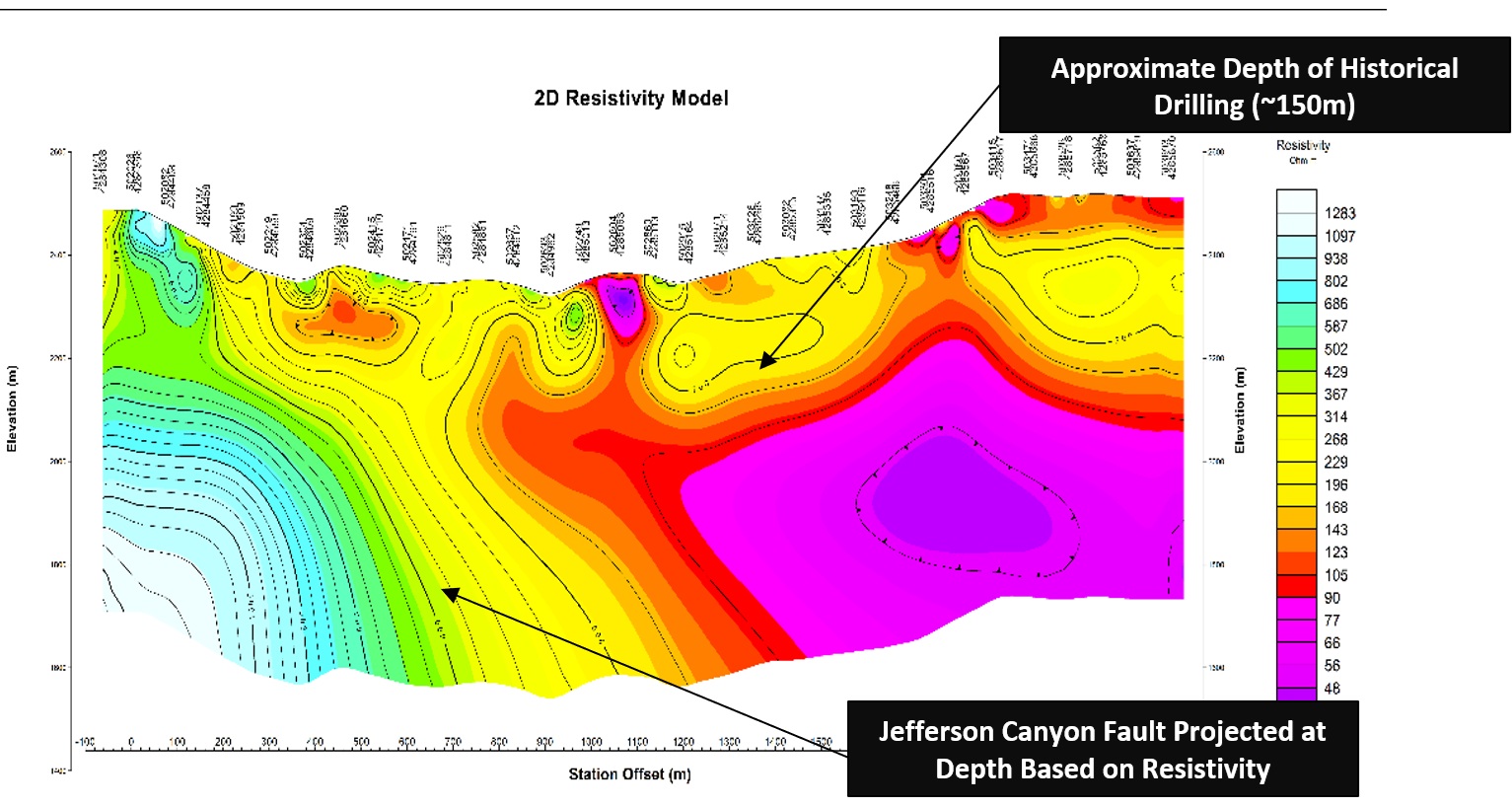
Figure 4: CSAMT /Resistivity Model Showing the Projection of the Jefferson Canyon Fault at Depth
To view an enhanced version of this graphic, please visit:
https://images.newsfilecorp.com/files/5717/316830_wpg-fig4.jpg
Link to Updated Jefferson Canyon Video
Key Remaining Terms of the Agreement:
- Kinross will continue making ongoing lease payments of US$75,000 per year for the term of the agreement.
- Kinross is required to spend US$600,000 on exploration work and will be responsible for making the payments to keep the unpatented claims in good standing.
- During the term of the agreement, Kinross has the option to acquire 70% of the project for a cash payment of US$5,000,000 to West Point Gold and form a joint venture LLC, and a second option to acquire an additional 10% of the project for a further payment of US$5,000,000 to the Company.
- The term of the Agreement is four years commencing from receipt of drill permits, with a potential extension of up to two years, subject to certain conditions. Drill permits were received on August 19, 2026.
- If an LLC is formed, and either party is diluted below 10%, its interest converts to a 1% net smelter returns (NSR) royalty.
Marketing Engagements
The Company has engaged New Era Publishing Inc. ("New Era"), also doing business as Katusa Research, an arm's-length service provider, to provide the Company certain investor relations and marketing services, in accordance with the policies of the TSX Venture Exchange and applicable securities laws. Based in Vancouver, B.C., New Era specializes in media and investor relations services within the natural resource sector. Under a consulting agreement dated September 8, 2026, New Era will provide media relations, investor communication and market awareness services to the Company for a two-month term for a one-time fee of US$150,000, payable at the commencement of services. The Company will not issue any securities to New Era as compensation for its services. As of the date hereof, to the Company's knowledge, New Era (including its directors and officers) does not own any securities of the Company. The marketing agreement with New Era is subject to TSX Venture Exchange approval.
Additionally, the Company has engaged Freedom Financial Research, LLC ("Freedom Financial"), an arm's-length service provider, to provide the Company certain investor relations and marketing services, in accordance with the policies of the TSX Venture Exchange and applicable securities laws. Based in Charlottesville, Virginia, Freedom Financial specializes in media and investor relations services. Under a consulting agreement dated September 11, 2026, Freedom Financial will provide media relations, investor communication and market awareness services to the Company for a 90-day term for a one-time fee of US$150,000, payable at the commencement of services. The Company will not issue any securities to Freedom Financial as compensation for its services. As of the date hereof, to the Company's knowledge, Freedom Financial (including its directors and officers) does not own any securities of the Company. The marketing agreement with Freedom Financial is subject to TSX Venture Exchange approval.
Qualified Person
Robert Johansing, M.Sc. Econ. Geol., P. Geo., the Company's Vice President, Exploration, is a qualified person ("QP") as defined by NI 43-101 and has reviewed and approved the technical content of this press release. The QP has not completed sufficient work to verify the historical information on the properties, particularly regarding historical drill results. However, the QP believes prior drilling and analytical results were completed in accordance with industry-standard practices.
About West Point Gold Corp.
West Point Gold is an exploration and development company focused on unlocking value across four strategically located projects along the prolific Walker Lane Trend in Nevada and Arizona, USA, providing shareholders with exposure to multiple discovery opportunities across one of North America's most productive gold regions. The Company's near-term priority is advancing its flagship Gold Chain Project in Arizona.
For further information regarding this press release, please contact:
Aaron Paterson, Corporate Communications Manager
Phone: +1 (778) 358-6173
Email: [email protected]
Stay Connected with Us:
LinkedIn: linkedin.com/company/west-point-gold
X (Twitter): @westpointgoldUS
Facebook: facebook.com/Westpointgold/
Website: westpointgold.com/
FORWARD-LOOKING STATEMENTS:
Certain statements contained in this press release constitute forward-looking information. These statements relate to future events or future performance. Forward-looking statements include estimates and statements that describe the Company's future plans, objectives or goals, including words to the effect that the Company or management expects a stated condition or result to occur. The use of any of the words "could", "intend", "expect", "believe", "will", "projected", "estimated" and similar expressions and statements relating to matters that are not historical facts are intended to identify forward-looking information and are based on the Company's current belief or assumptions as to the outcome and timing of such future events including, among others, assumptions about future prices of gold, silver, and other metal prices, currency exchange rates and interest rates, ability to define economic mineralization, favourable operating conditions, political stability, obtaining government approvals and financing on time, obtaining renewals for existing licenses and permits and obtaining required licenses and permits, labour stability, stability in market conditions, availability of equipment, availability of drill rigs, and anticipated costs and expenditures. The Company cautions that all forward-looking statements are inherently uncertain, and that actual performance may be affected by a number of material factors, many of which are beyond the Company's control. Such factors include, among other things: risks and uncertainties relating to West Point Gold's ability to complete any payments or expenditures required under the Company's various option agreements for its projects; and other risks and uncertainties relating to the actual results of current exploration activities, the uncertainties related to resources estimates; the uncertainty of estimates and projections in relation to production, costs and expenses; risks relating to grade and continuity of mineral deposits; the uncertainties involved in interpreting drill results and other exploration data; the potential for delays in exploration or development activities; uncertainty related to the geology, grade and continuity of mineral deposits; the possibility that future exploration, development or mining results may vary from those expected; statements about expected results of operations, royalties, cash flows, financial position may not be consistent with the Company's expectations due to accidents, equipment breakdowns, title and permitting matters, labour disputes or other unanticipated difficulties with or interruptions in operations, fluctuating metal prices, unanticipated costs and expenses, uncertainties relating to the availability and costs of financing needed in the future and regulatory restrictions, including environmental regulatory restrictions. The possibility that future exploration, development or mining results will not be consistent with adjacent properties and the Company's expectations; operational risks and hazards inherent with the business of mining (including environmental accidents and hazards, industrial accidents, equipment breakdown, unusual or unexpected geological or structural formations, cave-ins, flooding and severe weather); metal price fluctuations; environmental and regulatory requirements; availability of permits, failure to convert estimated mineral resources to reserves; the inability to complete a feasibility study which recommends a production decision; the preliminary nature of metallurgical test results; fluctuating gold prices; possibility of equipment breakdowns and delays, exploration cost overruns, availability of capital and financing, general economic, political risks, market or business conditions, regulatory changes, timeliness of government or regulatory approvals and other risks involved in the mineral exploration and development industry, and those risks set out in the filings on SEDAR+ made by the Company with securities regulators. Although the Company believes that the assumptions and factors used in preparing the forward-looking information in this corporate press release are reasonable, undue reliance should not be placed on such information, which only applies as of the date of this news release, and no assurance can be given that such events will occur in the disclosed time frames or at all. The Company expressly disclaims any intention or obligation to update or revise any forward-looking statements whether as a result of new information, future events or otherwise, other than as required by applicable securities legislation.
Neither the TSX Venture Exchange nor its Regulation Services Provider (as that term is defined in the policies of the TSX Venture Exchange) accepts responsibility for the adequacy or accuracy of this release.
To view the source version of this press release, please visit https://www.newsfilecorp.com/release/316830
